Point at the spot and say what is wrong.
The fix comes back on that render rather than as a new one, and the note is kept for every campaign after it.
The ad is nearly right, which is the expensive part
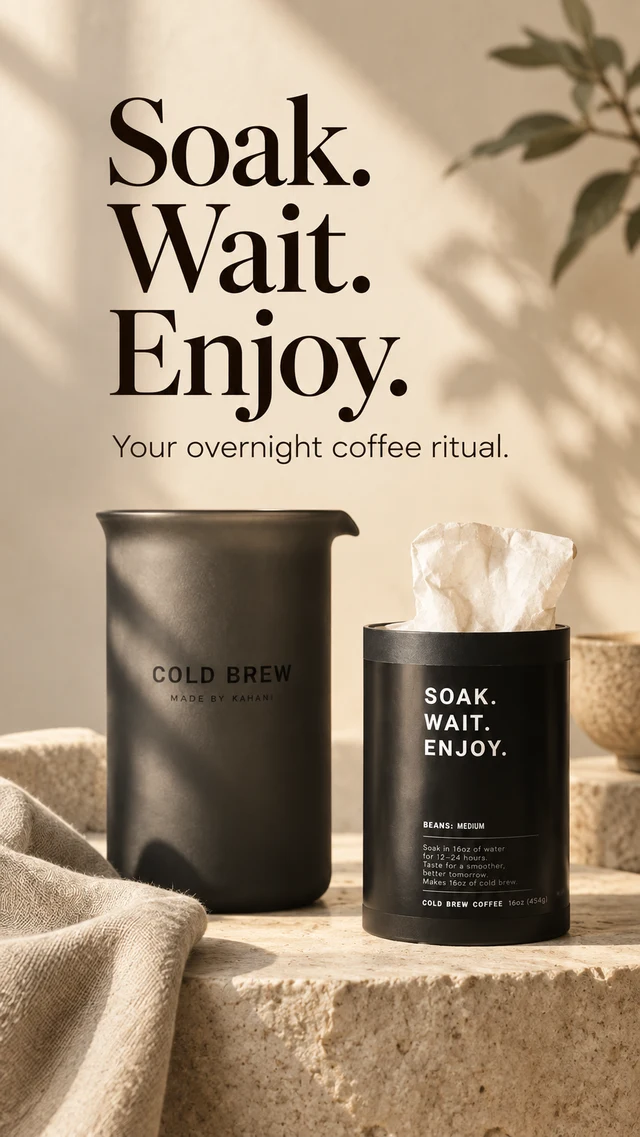
The picture came back good. The dose is in the wrong place, that is the glass bottle and the launch is the travel pack, and the claim on the second line is one you are not allowed to make. Three small things, and every one of them is the difference between running the ad and not running it.
With a generator, "nearly right" costs you the whole picture. You go back to the prompt, describe the problem in words the model has to reconstruct the scene from, and pay again for everything, including the parts that were already fine. Sometimes the fix lands and the thing you liked is gone.
Here you point at the spot on the finished ad and say what should be different there. The render you liked stays the render you liked.
| Fixing one thing | Rewriting the prompt | Pointing at it |
|---|---|---|
| What you describe | The whole picture, again | The one thing that is wrong |
| What you pay for | A new ad | One edit, whatever you queued on it |
| What happens to the version you liked | Replaced, and often lost | Untouched, and still in the version rail |
| Saying "this one, here" | A sentence the model has to place | A ring drawn on the pixel before the model sees it |
| Saying "like this" | Describe it and hope | Attach the picture to the note |
| Three notes on one ad | Three rewrites | One press |
It lands on the bottle you meant
Nomi draws your marker onto a copy of the ad before the model sees it. A point becomes a ring, a region becomes a frame. That is what makes "this one" mean the thing under your finger rather than the nearest thing your words could describe, which is the failure every prompt-based correction eventually hits: two bottles in the frame, and the model picks the wrong one.
Write the change the way you would say it to a designer. Make this headline shorter. Warmer light here. Attach a picture to the note and you have said "like this" without writing a sentence at all.
Point at the spot
Click the picture to mark a point, or drag to ring a whole region. The marker lands where you pointed with its note field already open.
Say what should change
In your own words. A picture attached to the note is a complete instruction on its own.
Queue everything you noticed
Each note lands as a row in the rail on the right. One creative is one edit whatever you wrote on it, so there is no reason to hold anything back.
Render once
The button states the price before you press it, and what comes back is a new version beside the one you started from.
Queue everything, then press once
Three notes on one ad cost what one does. That single fact changes how a review works: you stop rationing your corrections, and you stop shipping an ad with a small thing still wrong in it because raising it did not feel worth another render.
A page of ads is one job rather than one job per ad. Mark what is wrong on each of them where you see it, and the bar at the bottom counts what is waiting, as notes and as creatives, then sends the lot in one press. Each ad is redrawn on its own, so one that fails costs its own edit and nothing else.
The picture you started from is never touched. Every correction arrives as a new version, and the rail down the left of the canvas holds all of them, oldest at the top. A version whose render failed is retried from there.
The correction outlives the ad
A note you make once is not a note you make weekly. What you told it about the dose, the pack shot and the claim goes into what Nomi believes about your brand, filed under the subject it is about, with the day it was learned.
So the next campaign starts from the corrected version rather than from the first one. That page is yours to read and change, and a belief in it has to be your own words, copied out of a message you typed. Anything Nomi wrote itself, or read off a web page, is refused before it can be stored.
Fix the thing that will be wrong again next month, not just on this ad. A correction about your packaging is worth more in the brand's memory than in one render.
What it will not pretend
It asks for the picture again rather than taking it apart. There are no layers to open and no way to type a new line of text onto a finished ad.
It edits what it made. A file from somewhere else is an upload, and an upload has no render to reopen.
A change large enough to be a different picture is a different picture, and it says so instead of quietly redrawing everything you had approved.
No. There are no layers and no text tool. You say what should be different and the picture is made again with that change in it, which is why a correction reads like a note to a designer rather than a set of operations.
One edit per creative, whatever you queued on it. Three notes on one ad cost the same as one, and the button states the price before you press it.
No. The picture you started from stays exactly as it was, and every correction arrives as a new version beside it in the rail.
Yes. Attach one to the note. A picture on its own is a complete instruction and needs no words beside it.
Yes. Mark what is wrong on each of them, and the bar at the bottom sends the whole batch in one press. Each ad is redrawn on its own.
A marker you never wrote anything into disappears by itself, so a stray click costs nothing. Undo and redo cover everything you queue.
Yes, when the correction is about your brand rather than about one picture. It goes into what Nomi believes about you, in your own words, and you can read and change that page.